If there’s one exercise that I think is best for developing finger control, speed, and dexterity it has to be Hanon.
These exercises are named after their creator, Charles-Louis Hanon, and were published in 1873. There is criticism that the exercises are not “musical” enough, but I think there is still a lot of value in them.
The exercise Cassi will be focusing on today is the very first one. It’s a simple pattern, but it’s one you can vary to help develop control, hand independence, rhythm, and dynamics.
<< Download the Hanon sheet music for FREE here >>
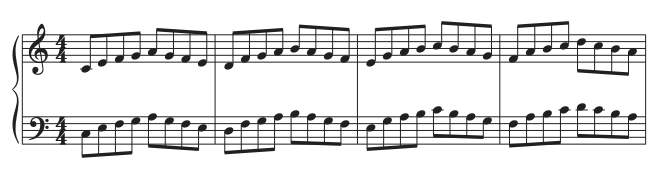
The exercise itself is quite simple. It involves climbing up the keyboard one octave. There is one skip to begin with, but everything else is a simple stepping pattern.
You can see the first line here. Notice how there’s a skip between the first two notes of each measure, and the pattern simply repeats up the scale:
I would really encourage you to master the basic pattern and exercise before moving on to any variations.
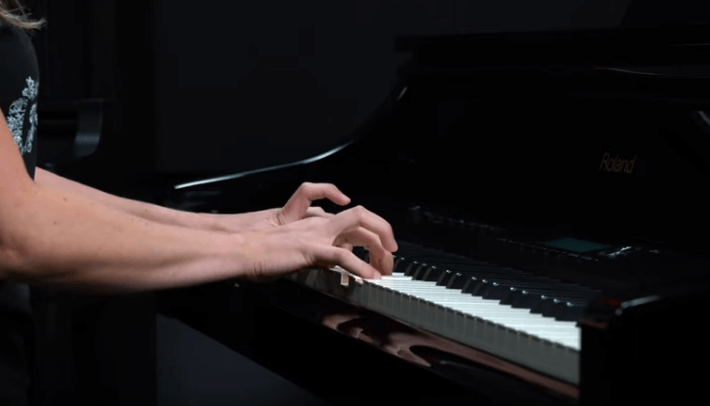
Once you can play the exercise comfortably, slow it down and lift each finger up before playing the note. What’s important here is to lift the finger with the natural curve that it already has. Do not curl the finger up even more, and do not straighten it either.
Don’t worry about speed here — focus on technique. This exercise helps with finger control and also the tone of your playing.
This exercise helps improve hand independence, and it is definitely easier said than done.
Try playing one hand staccato (very short and detached) while you play the other hand legato (smooth with no breaks).
Again, take it slow. Many people find their fingers cannot keep up with their brains. To really challenge yourself, try switching hands as you go!
This one is a lot easier, thankfully, and is a fun way to practice rhythms. Instead of playing simple eighth notes, try adding a swing rhythm to the exercise, or try playing the notes in separate groupings.
There are lots of possibilities here to play around with. Try making up some of your own!
Another difficult one, but this one will have a really big impact on your playing. I’ve said before that being able to control dynamics is the fastest way to go from a good player to a GREAT one.
This exercise is a good next step up from that.
Try playing one hand softly, and the other hand loud. Then swap. Change the volumes around and try to change volume as you’re playing.
I hope you can see how one simple exercise can be expanded to create something much more valuable. Don’t expect to be able to do all of these exercises on the first go. There’s a lot to take in here!
I’d encourage you to change it as much or as little as you want.
Mix and match and have fun!

Cassi Falk is trained as an Elementary and Intermediate Specialist through the Royal Conservatory Teacher Certification Program. She loves the feeling of accomplishment after a good practice session and seeing students discover music. Learn more about Cassi here.


By signing up you’ll also receive our ongoing free lessons and special offers. Don’t worry, we value your privacy and you can unsubscribe at any time.
We’re giving away 10 (TEN) 88-key digital pianos. The Pianote Prima is the perfect beginner piano. And one could be yours.
The winner will be chosen November 21st.
So enter today!
/marketing/pianote/promos/october/biggest-giveaway/header-image-2.webp)