
Did you know? If arpeggiated chords remind you of the harp, you may be onto something. The word “arpeggio” comes from the word “arpeggiare,” which means “to play upon the harp.” “Arpa” means harp!
Like scales, piano arpeggios are a very important skill. And they’re useful: arpeggios will help you master chords, develop dexterity, practice hand independence, and get comfortable moving up and down the keys. Plus, they just sound so nice!
Let’s back up for a second and break down what an arpeggio is. Then we’ll look at piano arpeggio techniques and a few piano arpeggio patterns you can practice.
Table of Contents:
Get exclusive interviews, fascinating articles, and inspiring lessons delivered straight to your inbox. Unsubscribe at any time.
An arpeggio is essentially a broken chord. We take a chord and roll through its notes one by one, bottom to top or top to bottom.
For example, an arpeggio built from the Am triad has three notes: A, C, and E. That’s the root, third, and fifth of the Am triad. To play this as an arpeggio, you’ll play these notes broken and add the root note on top.
| Left Hand Fingering | Notes | Right Hand Fingering |
|---|---|---|
| 5-3-2-1 | A-C-E-A | 1-2-3-5 |
You can extend an arpeggio across the whole piano by tucking under or crossing over, just like with scales.
Arpeggios aren’t just a series of notes. They’re the magic that turns chords into beautiful music.
Lisa Witt
Arpeggios abound in piano music. Some famous piano songs with arpeggios you might know include:
Piano arpeggios require a little more technique than basic broken chords. Because an arpeggio covers a lot of distance over the keyboard, it’s important to stay loose and relaxed when playing them. Use movement and mobility to reach all the notes.
Another tip: make sure you let go of notes right after you play them, this will help you loosen up!
There are tons of pretty arpeggio patterns you can play to spice up your chord progressions. Here are a few.
This is a perfect first arpeggio pattern for absolute beginners! All it involves is playing a broken triad, crossing over, and playing the root an octave up. Here it is played slowly.
Piano arpeggios make for excellent left-hand accompaniment. Here’s one accompaniment pattern you can try that involves stretching up to the third. Tip: let go of your pinky as soon as you reach up for that third.
We nickname this one the “spa” because it sounds so relaxing! It’s an arpeggio built from the root-fifth-root, with a few extra notes sprinkled on top. You can walk up these notes by crossing over any finger.
In this pattern, we play a rapid arpeggio in the left hand and slower notes from the chord in the right. This is a great exercise for practicing your chord shapes because you can apply this to any new chord you’re learning.
You can also switch this around and play fast arpeggios with your right hand and slow arpeggios with your left.
> Full Lesson With This Arpeggio Pattern
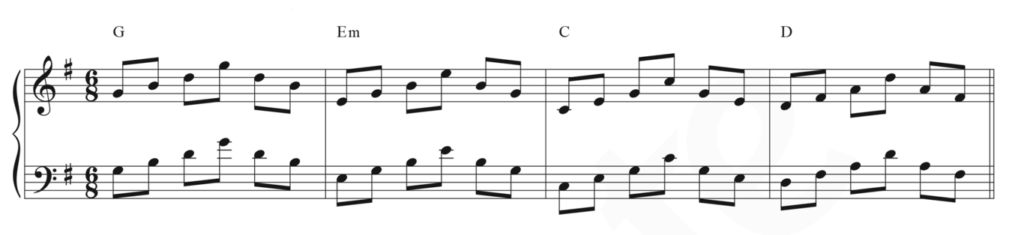
This is a very basic arpeggiated chord pattern that you’ll recognize from Leonard Cohen’s “Hallelujah.” Ty it out!
Here’s another arpeggiated chord pattern. Sound familiar? It’s used in Coldplay’s “Clocks”!
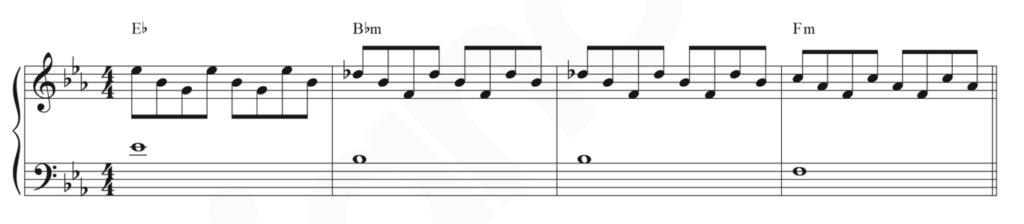
> Full Lesson With “Hallelujah” and “Clocks” Pattern
Instantly spice up your arpeggios by adding more notes! Here, we try adding a 9th—which is just another way of saying the second note from the root, only an octave higher. In this pattern, we just substitute the top note with the 9th.
This one sounds really neat! It involves adding the note a half step up from the third. The result is a spooky-sounding arpeggio! Try it with Am.
This arpeggio is built on a broken Cmaj7 chord. That’s C-E-G-B. And it sounds so dreamy! Try it in a cascading crossover, like this.
Jordan Rudess of Dream Theatre is known for his fast and fluid technique. Here’s his key tip: focus on motion, not the thumb tuck. Think of your entire arm as flowing to the right when arpeggiating up the keys.
In this lesson, Sangah Noona uses slash chords to make diatonic arpeggios sound super sophisticated. All this means is playing different broken diatonic chords over the same bass note used as a pedal point.
This one is more advanced, but you can start slow. Jesús plays two different power chords with his left hand and a Bsus4 chord in his right, then makes the whole thing a blur with a schnazzy cross-over.
The best way to learn piano is with real teachers, but not everyone has the time and money for a private instructor. At Pianote, you can get real feedback from real experts…all from the comfort of your own home. Explore our Method and community yourself with a free 7-day trial.
TRY PIANOTE FOR 7 DAYS
Lisa Witt has been teaching piano for more than 20 years and in that time has helped hundreds of students learn to play the songs they love. Lisa received classical piano training through the Royal Conservatory of Music, but she has since embraced popular music and playing by ear in order to accompany herself and others. Learn more about Lisa.

By signing up you’ll also receive our ongoing free lessons and special offers. Don’t worry, we value your privacy and you can unsubscribe at any time.
We’re giving away 10 (TEN) 88-key digital pianos. The Pianote Prima is the perfect beginner piano. And one could be yours.
The winner will be chosen November 21st.
So enter today!
/marketing/pianote/promos/october/biggest-giveaway/header-image-2.webp)