If you’ve ever wanted to learn a song quickly on the piano—without spending weeks glued to sheet music—let me introduce you to your new best friend: the lead sheet.
Lead sheets give you just the essentials: melody, chords, and rhythm. That’s it. No pages of complicated notes. No overwhelming arrangements. Just the core ingredients you need to play the song—while leaving plenty of room for your own creativity.
And today, I’ll walk you step-by-step through how to use a lead sheet to learn House of the Rising Sun.
But before that, make sure to download your lead sheet:
 Download The Sheet Music
Grab the sheet music for all the exercises in the lesson and practice at home.
We’ll also send you free lessons and special offers. Don’t worry, we value your privacy and you can unsubscribe at any time.
Here’s what a lead sheet includes:
For example, the lead sheet for House of the Rising Sun shows:
Even if you don’t read music fluently, you can pick out the melody by focusing on the note letters. For House of the Rising Sun, it starts like this:
A – C – E – D – A – A
All of these fit neatly under your five fingers in an A minor hand position. Play it slowly until it feels comfortable.
The chord symbols above the melody tell you what to play in your left hand. Start simple:
This “root note only” approach already gives your song structure without overcomplicating things.
When you’re ready, turn those single notes into full chords. Here’s the formula:
For House of the Rising Sun, your chords are:
Try playing them as broken chords (one note at a time) for a prettier, flowing sound.
Instead of playing the whole chord together, experiment with patterns like:
This adds movement and texture without making it more difficult.
Want to make your arrangement sound richer? Add notes from the chord below your melody note.
Example:
This fills out the sound beautifully and makes your arrangement uniquely yours
One of the biggest beginner mistakes is playing too fast. Start simple. Play slowly and cleanly. Once you feel bored with the simplicity—good! That’s when you’ll naturally start experimenting and making it your own.
Lead sheets give you freedom. You’re not stuck playing the exact arrangement someone else wrote—you can create your own. And once you understand how melody and chords work together, you can apply this to any song.
Inside Pianote, we have over 1,000 lead sheets you can play right now, plus my 5-day course that walks you through every step of playing from a lead sheet—just like I showed you here.
Start your free trial and explore my 5-day lead sheet course.

Lisa Witt has been teaching piano for more than 20 years and in that time has helped hundreds of students learn to play the songs they love. Lisa received classical piano training through the Royal Conservatory of Music, but she has since embraced popular music and playing by ear in order to accompany herself and others. Learn more about Lisa.
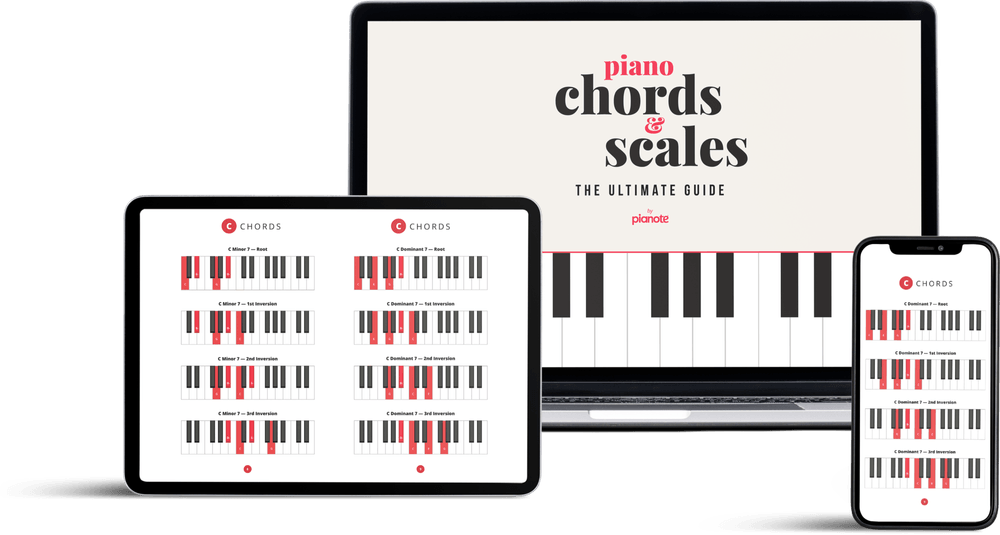

Enter your email address to get your FREE E-Book instantly.
By signing up you'll also receive our ongoing free lessons and special offers. Don't worry, we value your privacy and you can unsubscribe at any time.
We’re giving away 10 (TEN) 88-key digital pianos. The Pianote Prima is the perfect beginner piano. And one could be yours.
The winner will be chosen November 21st.
So enter today!
/marketing/pianote/promos/october/biggest-giveaway/header-image-2.webp)